Skip to content
Diamonds and their Imperfections

Diamonds and their Imperfections

To an untrained eye most diamonds look very similar in terms of quality. They are brilliant, shine and sparkle and are, simply put, beautiful.

What only a trained eye can see however - an inclusion in a diamond - is very important. An inclusion is a small - often very tiny, imperfection in a diamond that occurred as it formed, created due to the extreme heat and tremendous pressure they 'endure' as they form.

Perfect diamonds - that is a diamond that can be said to have not a single imperfection - are very rare. So rare in fact that most jewelers, even the most experienced, will never come across one, unless it is in a museum.

Accepting that you are also highly unlikely to encounter a perfect, flawless stone - and if you did it would almost certainly be out of your price range - just how much does an inclusion affect both a diamond's appearance and its value? The answer is it depends on the type of inclusion, the size and how many are contained within the single stone.

With all of this in mind, and in the interest of improving your diamond buying IQ, let's take a look.

Diamond Inclusion Types

Diamond inclusions can be divided into three main categories:
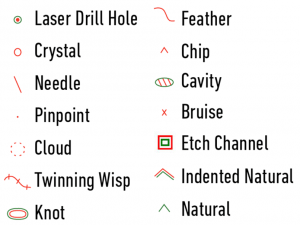
Complete-list-of-diamond-inclusion-types-in-GIA-a-plotting-diagram1-300x225

Pinpoint Inclusions

A pinpoint inclusion is the most common 'flaw' that's found in diamonds, both white diamonds and the rarer fancy colored diamonds.

A pinpoint inclusion is just what you might expect it to be from the name. Tiny dots - usually black - that can be observed on the table of the diamond. They often cannot be seen with the naked eye, meaning that when the stone is set, no one is going to point at it and shriek that your beautiful diamond has black spots. But pinpoint inclusions can be seen by experts and may lower a diamond's value.

pinpoint-inclusion-in-diamond-300x294

Feather Inclusions

Feather inclusions are also relatively common and can be more of a concern, especially in terms of a diamond's durability.

Feather inclusions are minute internal cracks, often deep within the stone. Should they run all the way from the top to the bottom of the stone they could affect the diamonds expected legendary durability, and so, once again, its value will be affected.

feather-inclusion-in-0.90-CARAT-G-SI2-EXCELLENT-CUT-ROUND-DIAMOND-300x293

Diamond Cavity Inclusions

The least common inclusion is a diamond cavity. We say least common as these are not really because a diamond with a cavity inclusion is rarely to be considered jewelry grade at all.

This is because the diamond literally has a cavity, the same kind you might develop in your tooth. Even if it is very small, the quality and durability of the stone is seriously compromised in most cases and it becomes best suited to industrial use. Given that there are plenty of uses for industrial diamonds it won't 'go to waste' but it is highly unlikely to be suitable for use in a ring or other high end diamond jewelry piece.

cavity-inclusion-in-1.00-CARAT-G-I1-EXCELLENT-CUT-ROUND-DIAMOND-300x297

Grading Inclusions

The business of grading diamond inclusions is not one left open to personal opinions. Third party diamond certification labs - like the GIA and the AGSL - are held to strict guidelines for the way an inclusion should be identified, classified and finally graded. Breaking this process down into the most basic of terms it goes a lot like this:


Identifying the Inclusion

The first step in the process is, naturally, determining that an inclusion exists at all and if it does what type it is.

Sizing

The size of the inclusion is important as well. Remember, we are not usually talking about something that is visible to the untrained, naked eye, so it takes both powerful tools and a great deal of expertise to determine the size of an inclusion properly.

Number

Some diamonds may have more than one inclusion. While this may not prevent it from being considered a valuable piece, it will lower that value, sometimes significantly.

Location

Where an inclusion is found on a diamond is another important grading factor. An inclusion at the bottom, or pavilion, of a diamond is less of a problem, as they grade diamonds from top to bottom, as it is the top that will be on the greatest display when the diamond is set.

It is also important that they categorize the inclusion as internal or external. Internal exclusions often, as we have mentioned, can compromise the structure and durability of the diamond so are naturally a more serious flaw.

Diamond Inclusions Effect on Value

Every inclusion will have some effect on value, some more so than others. A chip is more noticeable than a feather inclusion, but its size may still make it a larger flaw if it compromises the diamond's structural integrity.

All of this will be noted on the certificate of value a diamond is eventually given, but is should be noted that that will almost always occur before the diamond is set. Setting is a delicate process, and is it possible for the diamond to be damaged at that stage of its journey from the Earth's core to an engagement ring .

Final Thoughts

As there are so few truly flawless diamonds in the world a minor inclusion is no bar to getting the most stunning of diamonds. The important thing however is that a jeweler informs you they are there, which reputable ones will do via a GIA certificate. When purchasing diamonds - either loose or set - getting that all important verification is a must.

GRS-certified natural Burma sapphire ring — an example of authoritative gemstone certification at Astteria

WGI - World Gemological Institute: What You Sho...

WGI - the World Gemological Institute -  is one of the lesser-known grading labs buyers encounter. This guide answers the questions most articles don’t: what WGI actually is, where it...

WGI - World Gemological Institute: What You Sho...

WGI - the World Gemological Institute -  is one of the lesser-known grading labs buyers encounter. This guide answers the questions most articles don’t: what WGI actually is, where it...

Read More
Blue Tourmaline Jewelry: Astteria's Finest Indicolite & Paraiba Pieces

Blue Tourmaline Jewelry: Astteria's Finest Indi...

Discover Astteria's top 3 blue tourmaline jewelry pieces — from a 4.92 ct indicolite ring to a rare 18.91 ct Paraiba tourmaline necklace. A guide to the rarest blue gemstones...

Blue Tourmaline Jewelry: Astteria's Finest Indi...

Discover Astteria's top 3 blue tourmaline jewelry pieces — from a 4.92 ct indicolite ring to a rare 18.91 ct Paraiba tourmaline necklace. A guide to the rarest blue gemstones...

Read More
What Does a $150,000 Engagement Ring Actually Look Like?

What Does a $150,000 Engagement Ring Actually L...

When a diamond ring crosses the $150,000 threshold, you are no longer just buying jewelry; you are acquiring a rare natural asset. At this level, every decimal point in a...

What Does a $150,000 Engagement Ring Actually L...

When a diamond ring crosses the $150,000 threshold, you are no longer just buying jewelry; you are acquiring a rare natural asset. At this level, every decimal point in a...

Read More
Let’s Get To Know The Gemstone Called Cubic Zirconia

Let’s Get To Know The Gemstone Called Cubic Zir...

  Cubic zirconia is a man-made gemstone made from zirconium oxide and cubic zirconium and is harder than natural diamonds.  It comes in many colours, but the most popular are white and yellow....

Let’s Get To Know The Gemstone Called Cubic Zir...

  Cubic zirconia is a man-made gemstone made from zirconium oxide and cubic zirconium and is harder than natural diamonds.  It comes in many colours, but the most popular are white and yellow....

Read More
Canary Diamonds Vs Yellow Diamonds : Are There Significant Differences?

Canary Diamonds Vs Yellow Diamonds : Are There ...

Are you considering purchasing a diamond but feeling overwhelmed by the various colours available? One common question often arises in the diamond-buying process is the difference between canary diamonds and yellow diamonds. ...

Canary Diamonds Vs Yellow Diamonds : Are There ...

Are you considering purchasing a diamond but feeling overwhelmed by the various colours available? One common question often arises in the diamond-buying process is the difference between canary diamonds and yellow diamonds. ...

Read More
A Comprehensive Breakdown On How Grading Yellow Diamonds Work

A Comprehensive Breakdown On How Grading Yellow...

When purchasing a yellow diamond, grading is an important factor to consider. Grading helps determine a yellow diamond's quality, rarity, and value, making it an essential part of the diamond-buying process. But how does...

A Comprehensive Breakdown On How Grading Yellow...

When purchasing a yellow diamond, grading is an important factor to consider. Grading helps determine a yellow diamond's quality, rarity, and value, making it an essential part of the diamond-buying process. But how does...

Read More
Yellow Sapphires Vs Yellow Diamonds: A Comprehensive Comparison

Yellow Sapphires Vs Yellow Diamonds: A Comprehe...

When it comes to choosing the perfect yellow gemstone for an engagement ring or other jewellery, it can be a difficult decision to make. Both yellow sapphires and yellow diamonds are popular choices for...

Yellow Sapphires Vs Yellow Diamonds: A Comprehe...

When it comes to choosing the perfect yellow gemstone for an engagement ring or other jewellery, it can be a difficult decision to make. Both yellow sapphires and yellow diamonds are popular choices for...

Read More
From Canary To Olive: Exploring The Shades of Yellow-Green Diamonds

From Canary To Olive: Exploring The Shades of Y...

Diamonds come in various colours, and yellow-green diamonds are a unique and mesmerizing option growing in popularity. From the bright and sunny shade of canary yellow to the rich and earthy tones of olive...

From Canary To Olive: Exploring The Shades of Y...

Diamonds come in various colours, and yellow-green diamonds are a unique and mesmerizing option growing in popularity. From the bright and sunny shade of canary yellow to the rich and earthy tones of olive...

Read More
Debunking The Price Myth: Are Yellow Diamonds More Expensive Than White?

Debunking The Price Myth: Are Yellow Diamonds M...

Diamonds are undoubtedly one of the most sought-after gems in the world, and they come in a wide variety of colours, from classic white to rare and exotic hues like...

Debunking The Price Myth: Are Yellow Diamonds M...

Diamonds are undoubtedly one of the most sought-after gems in the world, and they come in a wide variety of colours, from classic white to rare and exotic hues like...

Read More
What Is Diamond Cut Gold: A Comprehensive Overview

What Is Diamond Cut Gold: A Comprehensive Overview

Diamond-cut gold is a unique and stunning material that has recently gained popularity in jewellery. It is a type of gold cut in a way that creates a sparkling effect, similar...

What Is Diamond Cut Gold: A Comprehensive Overview

Diamond-cut gold is a unique and stunning material that has recently gained popularity in jewellery. It is a type of gold cut in a way that creates a sparkling effect, similar...

Read More